AegisCode
An enterprise-grade autonomous software engineering platform coordinating specialized agents (Supervisor, Researcher, Coder, Tester, Security, Reviewer) to inspect GitHub repositories, plan modifications, execute code in isolated sandboxes, run regression suites, verify security guardrails, and open verified Pull Requests.
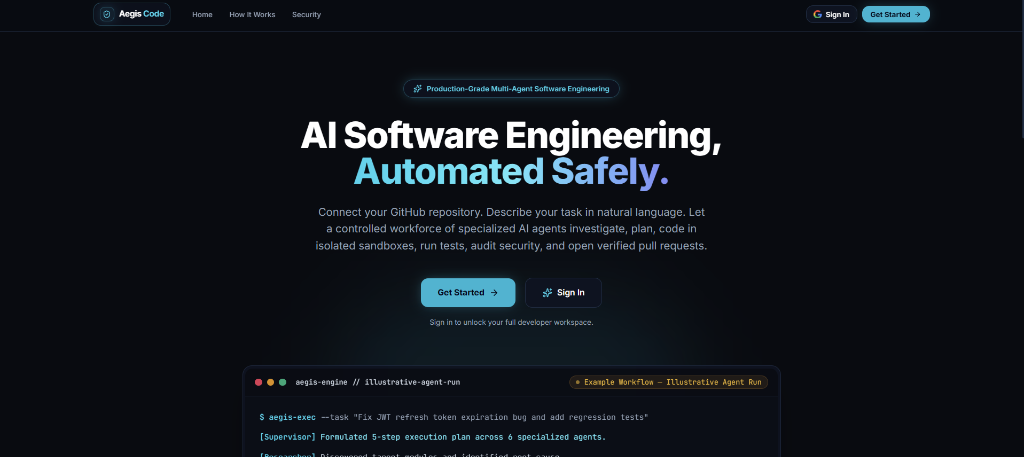
Tech stack
Impact
Problem Statement
Autonomous coding assistants often produce hallucinated patches, introduce security vulnerabilities, or overwrite code without proper isolation, test verification, or human sign-off on critical production branches.
Dataset
Multi-repository AST call graphs, commit histories, GitHub issue specifications, and dependency trees parsed in real-time.
Architecture
LangGraph deterministic state machine orchestrating 6 specialized agents (Supervisor, Researcher, Coder, Tester, Security, Reviewer). Backed by FastAPI SSE event broadcasting, MongoDB Atlas audit storage, pluggable Docker sandboxes for untrusted code execution, and a responsive Next.js 15 command center.
Model Selection
Hybrid LLM routing leveraging high-capacity reasoning models for task planning and code architecture, with low-latency models for AST parsing and code reviews. Implements Model Context Protocol (MCP) and Agent-to-Agent (A2A) capability negotiation.
Training Process
Rigorous prompt engineering, bounded repair loops (max 3 diagnostic retry iterations on failed tests), input prompt-injection filtering, and security AST scanning for SSRF, injections, and leaked secrets.
Evaluation Metrics
Results
A production-ready AI software engineering platform deployed across Vercel and Render, capable of autonomous bug fixing, regression testing, and opening production-verified GitHub Pull Requests with full audit trails.
Key Learnings
- 1Multi-agent specialization (separating Planner, Coder, Tester, Security, and Reviewer) prevents single-prompt hallucination cascades.
- 2Running all test executions inside ephemeral, resource-constrained Docker containers is essential for safe autonomous code execution.
- 3Risk-gated human-in-the-loop checkpoints build critical developer trust before mutating production repositories.
Want to dig deeper?
Explore the code, or get in touch if you'd like to talk through the approach.