Git Debug Agent
An autonomous debugging and code intelligence platform that isolates defect root causes using GraphRAG and TypeScript AST intelligence, performs 3-way merge conflict resolution, validates patches with Critic Agent guardrails, runs CI pipeline triage, and coordinates safe Git operations with push safeguards.
Tech stack
Impact
Problem Statement
Software debugging, regression isolation, and merge conflict resolution are tedious, high-stakes tasks. Developers often struggle to trace root causes across complex dependencies or risk pushing unvetted patches directly to production branches.
Dataset
Multi-repository codebases analyzed via TypeScript Compiler AST extraction, generating 384-dimensional semantic feature vectors, symbol dependency call graphs, and unified diff hunks.
Architecture
A 28-state autonomous state machine orchestrating TaskPlanner, ContextBuilder, HypothesisEngine, CriticAgent, and PatchEngine. Features Express.js REST + SSE streaming, Windows native PowerShell folder dialogs, safe direct execFile('git') execution with 19 operation safety tiers, and MongoDB Atlas vector storage.
Model Selection
Groq Llama 3.3 70B selected for high-velocity multi-step reasoning, hypothesis generation, and patch synthesis, integrated with Hybrid Reciprocal Rank Fusion (RRF) for precise code symbol retrieval.
Training Process
Strict safety guardrails and 10 comprehensive automated test suites (Git engine, agent state machine, API, guardrails, change analyzer, E2E workflow, recovery snapshot rollbacks, and GraphRAG security).
Evaluation Metrics
Results
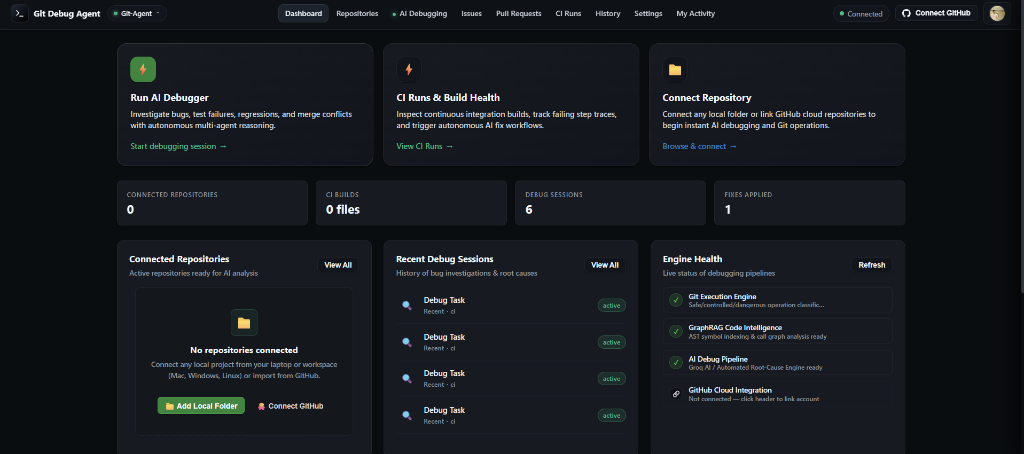
A production-ready code intelligence platform with 9 modular views (Dashboard, Repositories, AI Debugging, Issues, PRs, CI Runs, Conflict Center, History, Admin), supporting automated Git bisect, rollback snapshots, and side-by-side 4-way merge resolution.
Key Learnings
- 1AST symbol indexing combined with dependency graph traversal delivers exponentially more accurate bug localization than naive vector search.
- 2A dedicated Critic Agent safety gate is indispensable to catch regressions and prevent dangerous shell commands before patches are committed.
- 3Classifying Git operations into safe, controlled, and dangerous tiers prevents catastrophic accidental force pushes to protected branches.
Want to dig deeper?
Explore the code, or get in touch if you'd like to talk through the approach.